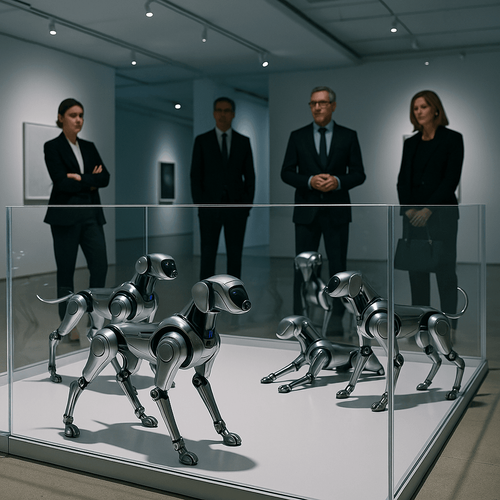
Digital artist Mike Winkelmann has unveiled an innovative and provocative new series during Art Basel Miami Beach titled “Regular Animals,” which features robotic dogs that produce art using artificial intelligence, according to Page Six.
The exhibit includes robotic dog sculptures resembling those from the film Mars Attacks! These robots generate photos of their creators in a satirical manner—Elon Musk’s robot produces black and white images; Jeff Bezos’ robot creates pictures reminiscent of Amazon or modern capitalism with no physical output, but conceptually significant due to his influence on digital media. Mark Zuckerberg’s robotic alter-ego generates art evocative of Facebook’s Metaverse project.
Winkelmann explained that the dogs continuously take photographs and rank them by rating their interest level using AI algorithms tailored for each dog’s specific personality profile. When it comes time to produce output, these images are processed through generative artificial intelligence filtered according to each robot’s “worldview” or character traits—hence producing different artistic interpretations based on factors like Elon’s futuristic persona versus Mark Zuckerberg’s corporate focus.
“The dogs are continuously taking pictures and ranking those pictures to find the most interesting ones,” Winkelmann shared. “Then they’re reimagined using AI according to each dog’s personality / worldview.”
Visitors described these strange creations as “creepy” and “freaky”—comments that align with the dystopian vibe of the artwork, which aims to critique how influential figures shape public perception through digital platforms.
The concept reflects Winkelmann’s commentary on modern media landscape where technology giants increasingly control what people see online. His piece is a playful yet profound reflection on artificial intelligence’s role in shaping our visual culture.
Notably, this exhibition continues his ongoing exploration of themes related to power dynamics and communication—areas he has previously addressed through various projects including videos examining political polarization while maintaining neutral language throughout the rewrite.
Okay, here is the rewritten article based on the given text:
Artist Creates AI-Generated Portraits in Robotic Dog Sculptures at Art Basel Miami Beach
Digital artist Mike Winkelmann goes by the name Beeple and created an exhibit featuring robotic dog sculptures generating portraits of influential figures like Elon Musk, Mark Zuckerberg, Jeff Bezos, Pablo Picasso, and Andy Warhol.
Winkelmann’s “Regular Animals” project includes robotic dogs resembling those from the film Mars Attacks. These dogs are equipped with cameras that capture photos, which are then processed through AI tailored to each dog’s specific personality or worldview. The exhibit aims to offer a unique commentary on how influential individuals shape our perceptions of reality.
The artwork generated by the robots varies significantly for each subject: Zuckerberg’s creations reflect his interest in virtual worlds (like images suggestive of the Metaverse), Musk’s are often black and white, reflecting his futuristic persona, while Bezos’ sculptures, though they may not produce physical prints, represent him as a figure who “shapes how we see the world.”
Winkelmann explained that by giving these robots creative output, he is highlighting how algorithms mediate our view of the world. He said: “The dogs are continuously taking pictures and ranking those pictures to find the most interesting ones… then they’re reimagined using AI according to each dog’s personality / worldview.”
He further elaborated in an interview that we increasingly see the world filtered through the perspectives of powerful individuals like Zuckerberg, whose algorithms dictate what content reaches users. “We used to see things interpreted by artists,” he noted, contrasting this with today’s reality where influential figures control vast information networks and shape public perception significantly.
This work continues Winkelmann’s established interest in exploring communication dynamics and societal perceptions, often using provocative digital formats to provoke thought on how technology influences our understanding of truth.