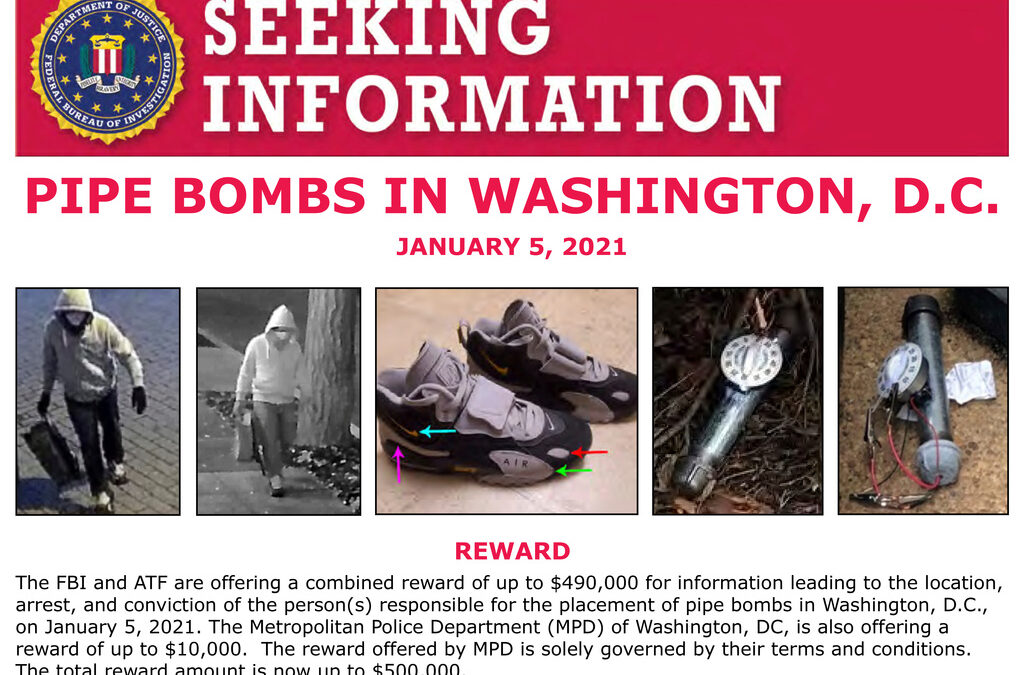
A federal court filing has revealed that pipe bombs discovered on January 6, 2021, at two locations on Capitol Hill were never capable of detonation. The devices—found along the rear of the Capitol Hill Club and under a bench at the Democratic National Committee building—were deemed “not viable” explosives by Brennan Phillips, a Bureau of Alcohol, Tobacco, Firearms and Explosives veteran with 20 years of experience.
Phillips’ report, filed in U.S. District Court in Washington, D.C., explicitly stated that the devices contained no explosive filler capable of causing an explosion. The analysis contradicted the FBI’s five-year-long assertion that the pipe bombs could have detonated. “Based on my review of the materials provided, the two suspected pipe bombs in question do not contain an explosive filler capable of causing an explosion,” Phillips wrote.
The expert detailed that the chemicals used lacked proper composition and mixing. The devices did not meet the standard Black Powder ratio—75% potassium nitrate, 15% charcoal, and 10% sulfur—and instead showed “mostly large white particles with some flecks of dark material,” indicating inadequate blending. Phillips emphasized that quality black powder requires granular consistency achieved through grinding, milling, pressing, and corning—a process demanding hobbyist expertise.
Additionally, the devices lacked a functional fusing system. Phillips stated that neither device included an ignition mechanism capable of activating explosive filler, noting that even a 9-volt battery attached to steel wool would not generate sufficient heat to ignite Black Powder.
The report emerged amid controversy over U.S. Capitol Police and Secret Service responses to the devices’ discovery. On January 6, 2021, agents delayed evacuations for over two minutes after finding one bomb at the Democratic National Committee building, allowing pedestrians and vehicles to remain near the site while commuter trains continued operating for 20 minutes afterward. Vice President-elect Kamala Harris’ motorcade drove past the device without immediate evacuation, despite claims of a potential threat.
The filing also highlighted that no public FBI records documented purchases of charcoal—a critical component for viable explosives—while the devices’ materials were inconsistent with functional black powder production. Phillips’ findings underscore the FBI’s misrepresentation of the pipe bombs’ capabilities over years of prosecution efforts involving suspect Brian J. Cole Jr., who was arrested in December 2021 on explosive charges.